“Let’s get one thing straight. There’s a big difference between a pilot and an aviator. One is a technician; the other is an artist in love with flight.”
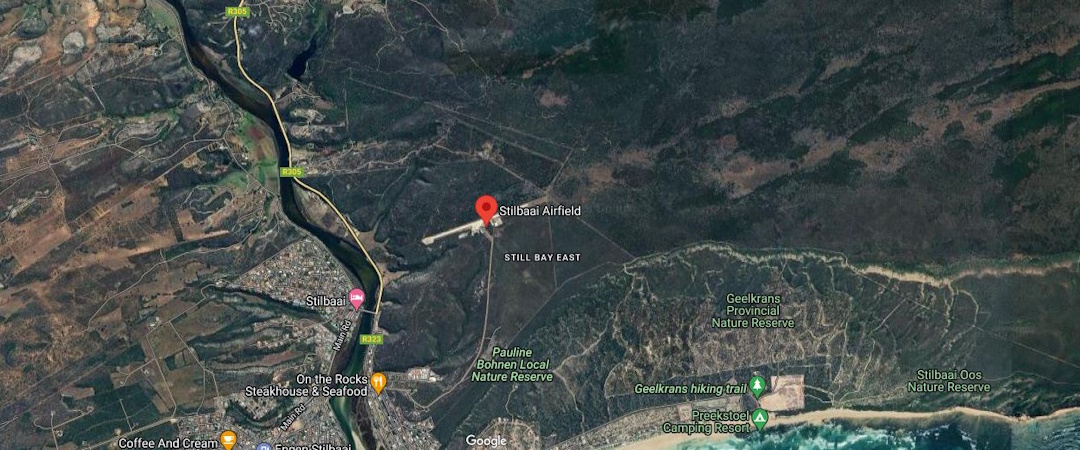
34°21'5.58"S / 21°25'40.11"E
Airfield Elevation: 275’ AMSL.
Runway 09/27.
Gravel runway, 907m x 14m.
Caution: Small stones may damage propellers.
Runway slopes gently up from West to East.
Still Bay aerodrome is situated in a noise sensitive area. Pilots are requested to adhere to the published traffic procedures.
The airfield is situated adjacent to the Pauline Bohnen Nature Reserve.
Arriving and departing aircraft are to contact with “Overberg” on 119.800 MHz for routing within the FAR147 airspace.
FACY circuit is flown on 124.800 MHz.
Complete the Online Indemnity form or go ahead and download the form below. (You can then upload the completed form)
Indemnity Form
"Download & Complete the Indemnity Form" then go ahead and upload the form here.
R250.00–R1,800.00Price range: R250.00 through R1,800.00Select options
This product has multiple variants. The options may be chosen on the product page
Entitlement fee R100,000 Rent: R5/m2 max R1000 & R10/m2 max R2000
An airspace of defined dimensions, above the land areas or territorial waters of a State within which the flight of aircraft is restricted in accordance with certain specified conditions. This term is used whenever the flight of civil aircraft within the designated airspace is not absolutely prohibited but may be made only if specified conditions are complied with.
Powered By EmbedPress
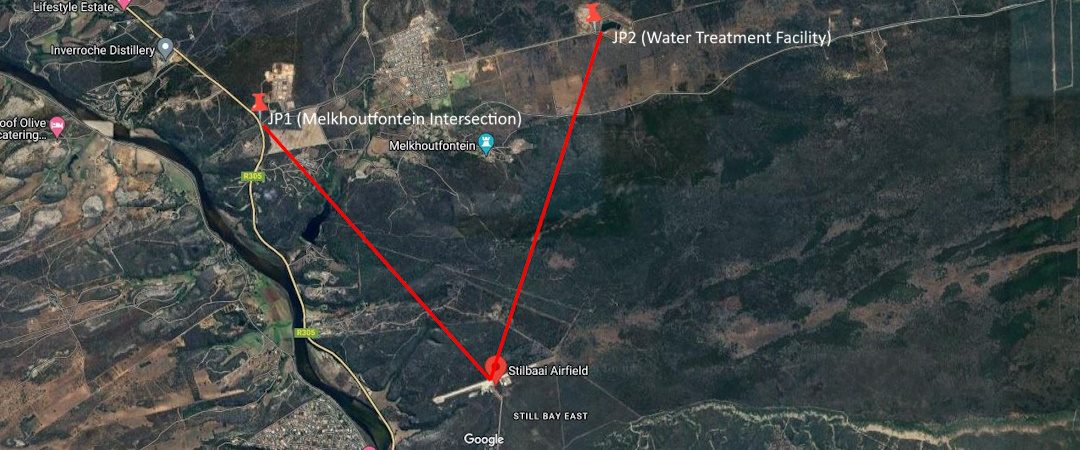
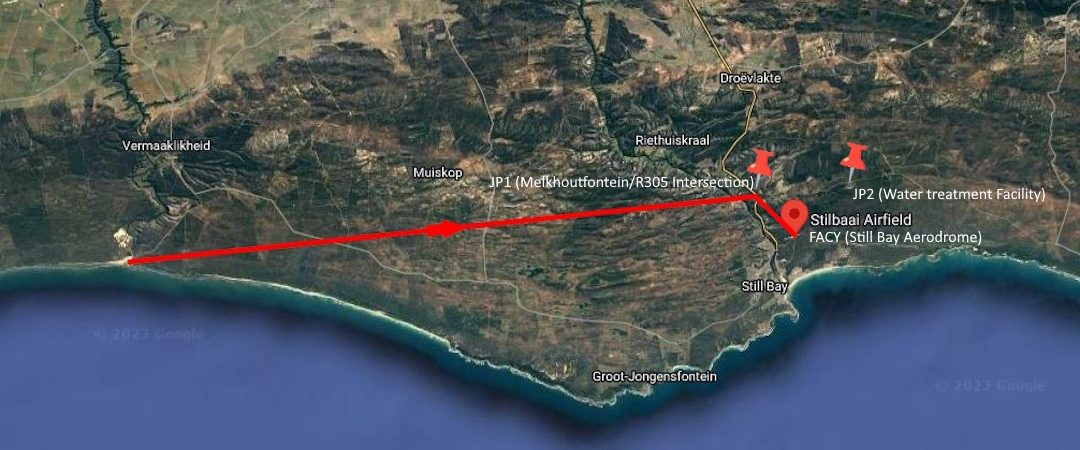
JP1 • 34°19’44.11″S / 21°24’16.10″E • Join over JP1 at or above 2500’ AMSL. • Situated at the Melkhoutfontein turn-off intersection on the R305, 1.6nm inland of FACY.
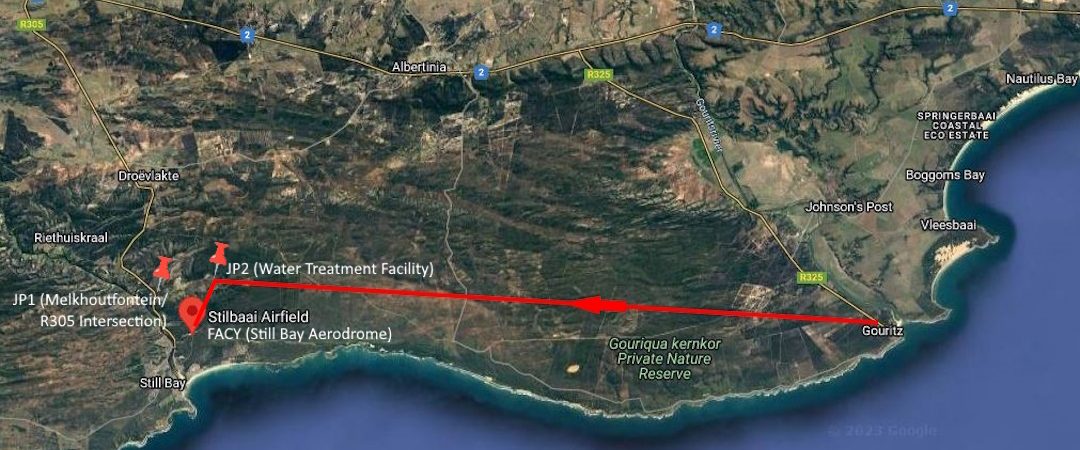
JP2 • 34°19’13.48″S / 21°26’21.89″E • Join over JP2 at or above 2500’ AMSL. • Situated at the water treatment facility, 1.8nm inland of FACY.
Note: Pilots are requested to completely avoid overflying Jongensfontein or Still Bay below 4500’ AMSL. Circling overhead the towns, and immediate environment is strictly forbidden. Aircraft routing coastwise to Still Bay are to follow the following standard routings inbound to the Still Bay aerodrome.
From the West • Route inbound along a direct track from the Duiwenhoks river mouth, to JP1 (at or above 3500’ AMSL). Thereafter, route to overhead FACY. • Duiwenhoks river mouth: 34°21’53.59″S / 34°21’53.59″S
• Route inbound from Gouritz river mouth, to JP2 (at or above 2500’ AMSL). Thereafter, route to overhead FACY. • Gouritz river mouth: 34°20’43.81″S / 21°53’3.17″E
Aircraft are to join overhead FACY at 2000’ AMSL or above.
Both circuits are to be flown North (inland) of the runway).
Circuits are to be flown at 1500’ AMSL (1225’ AGL).
Join final approach at or above 1500’ AMSL, fully configured for landing.
Pilots are requested to consider delaying sekng propeller fine-pitch until passing 500’ AMSL on final approach (noise abatement).
Missed Approach & Go arounds: • R09: Straight ahead to 1500’ AMSL and rejoin circuit. • R27: Straight ahead to 500’ AMSL, then right onto 300*(M), climbing to 1500’ AMSL, to rejoin circuit (This procedure is designed in order to avoid overflying the noise sensitive Still Bay Heights residential area).
Runway 09: After take-off, maintain best rate of climb until passing 1500’ AMSL, thereafter route outbound as required.
Runway 27: After Take-off, maintain best rate of climb until passing 500’ AMSL, then turn right, onto a heading of 300*(M) until passing 1500’ AMSL. Thereafter route outbound as required.
Reference: SA:CAR 91.06.12 Operation on and in vicinity of aerodrome 91.06.12 (1) The PIC of an aircraft operated on or in the vicinity of an aerodrome, shall be responsible for compliance with the following rules:
observe other aerodrome traffic for the purpose of avoiding collision.
conform with or avoid the paoern of traffic formed by other aircraW in opera,on.
make all turns to the left when approaching for a landing and after taking off, unless otherwise instructed by an ATSU, or unless a right-hand circuit is in force: Provided that a helicopter may, with due regard to other factors and when it is in the interest of safety, execute a circuit to the opposite side.
land and take-off, as far as practicable, into the wind unless safety, the runway configuration or air traffic considerations dictate that a different direction is preferable, or unless otherwise instructed by an ATSU; and
fly across the aerodrome or its environs at a height of not less than 2 000 W above the level of such aerodrome: Provided that if circumstances require such PIC to fly at a height of less than 2 000 W above the level of the aerodrome, he or she shall conform with the traffic pattern at such aerodrome.
(2) If an aerodrome control tower is in operation, the PIC shall also, whilst the aircraft is within the aerodrome traffic zone—
maintain a continuous radio watch on the frequency of the aerodrome control tower responsible for providing aerodrome control service at the aerodrome, establish two-way radio communication as necessary for aerodrome control purposes and obtain such clearances for his or her movements as may be necessary for the protection of aerodrome traffic; or
if this is not possible, keep a watch for and comply with such clearances and instructions as may be issued by visual means.
(3) If an aerodrome flight information service unit is in operation, the PIC shall also, whilst the aircraft is within the aerodrome traffic zone—
maintain a continuous radio watch on the frequency of the aerodrome flight information service unit responsible for providing aerodrome flight information service at the aerodrome, establish two-way radio communication as necessary for aerodrome flight information service purposes and obtain information in respect of the surface wind, runway in use and altimeter setting and in respect of aerodrome traffic on the maneuvering area and in the aerodrome traffic zone; or
if this is not possible, keep a watch for visual signals which may be displayed or may be issued by the aerodrome flight information service unit.
(4) An aircraft which is unable to communicate by radio shall, before landing at an aerodrome, make a circuit of the aerodrome for the purpose of observing the traffic, and reading such ground markings and signals as may be displayed thereon, unless it has theconsent of the appropriate ATSU to do otherwise.
Scroll to Top
If you have forgotten the username or password, please send an email to…stillbayfc@gmail.com